LO4 - Professional standards
Before starting with the project me and my team decided that we need to make an agreement within ourselves to make sure everyone does their part in the working process. The easiest way to do that was to create and sign a contract. When we set up Teams group we created a document and each one of us wrote down their personal information such as a full name, phone number and other ways to contact. Then we wrote down some important things as rules in the team, the collaborations, deadlines and so on. I also suggested we write down the stand up meetings schedule in there so it becomes a mandatory rule we cannot randomly skip. I wrote those down and once we got everything, we signed the document thus giving consent to the written rules above and making it formal.
This is the first time I applied this exact practice and I must say it is a nice way to organize the team. If at some point one of us stopes working, or starts skipping classes, we would have all the evidence that they agreed upon the rules and violated them, thus making it fair to kick this person out of the team.
After creating the contract we created a Team charter in which we could assign roles and set up a strike system. The team struggled with choosing roles so I suggested we write down the specializations that each one of us are good at and then we would divide the roles. I wrote that some of my strengths are: Information Architecture and Navigation Design, User-Craft Design, Front-End Web Wizard. After encouraging people to just pick a few things they are good at and write them down I already got a better idea of what roles could be assigned to whom. By the end of the process, I suggested that we assign roles by skill, but it wouldn’t mean that only one person does something and another won’t do anything connected to it. It just meant that all of us would be the main person on the topic. For example if teachers/companies/clients have a question about the design parts of the project, I would have to talk with them. This way we make sure that everyone has a part in designing, developing, research, but there are just specific people who have to be the face of a topic. In the contract we also set up a strike system. If you skip classes without telling the team or are always late, you will be getting yellow strikes, then red and then be kicked out of the team. The last thing in the document are Risks charts that would help us fix and avoid simple problems that might occur within our team.
I believe that this system works and is effective, but there is a small downside to it, if we need to put up a strike on someone because they obeyed rules, then everyone would know who did it(because of teams document history) and that may cause problems, because people wouldn’t want to be the ones who put a strike against someone.
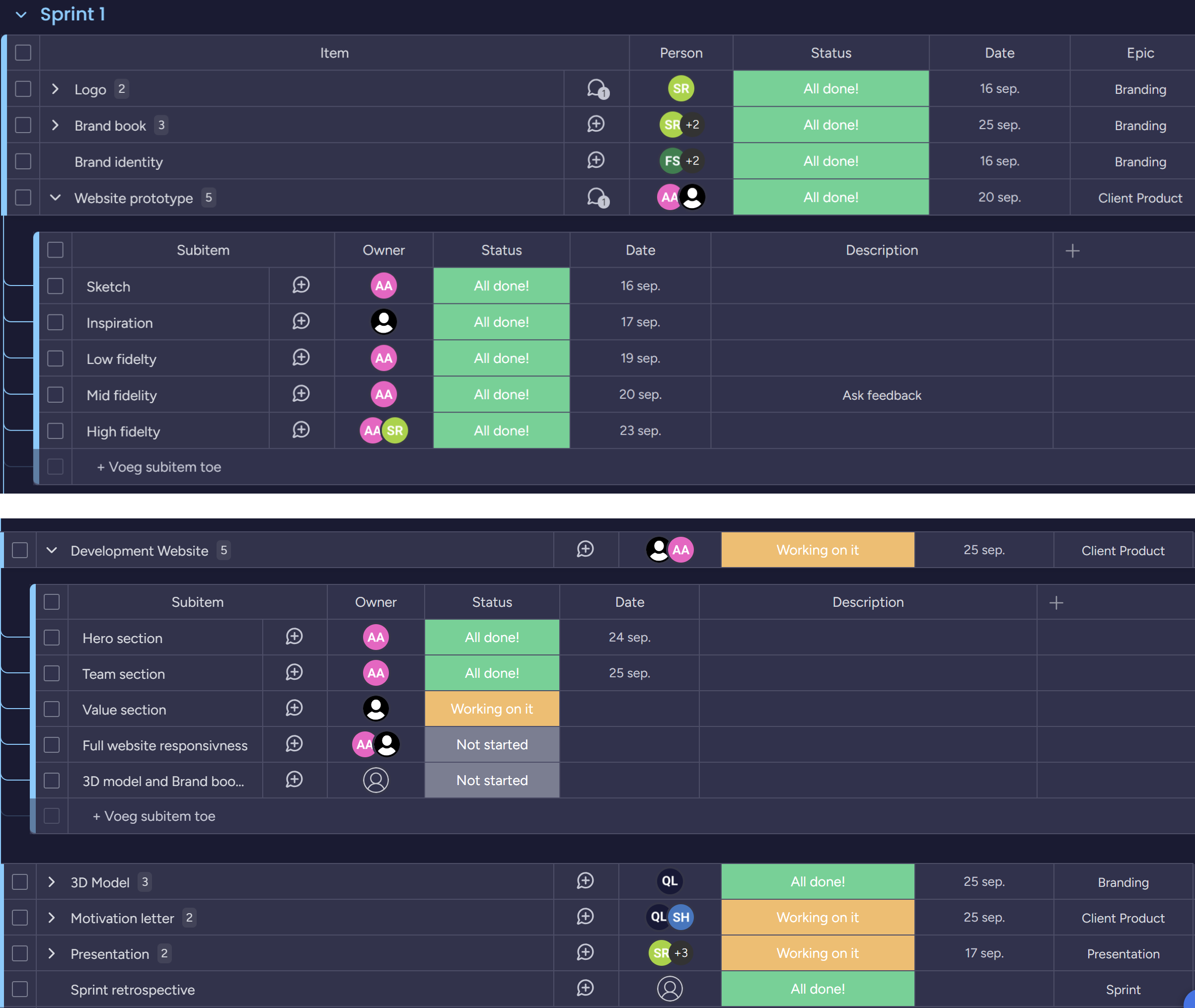
In order to plan our work in a team, divide tasks and have a control over the work flow we used the scrum method.
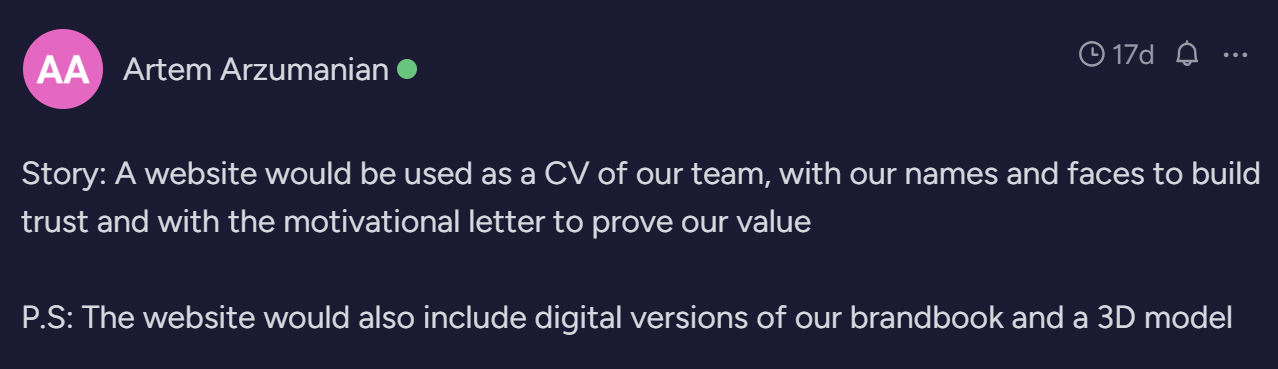
That’s where Monday comes in. This is a project management software that is heavily advertised on Youtube, so that’s how they got in our heads. We chose a Scrum master that would facilitate the workflow process and then organized sprints in which we would have set deliverables. I added myself to certain tasks, consulting with everyone beforehand and created subitems to the product that I would have to deliver. For example for a “website prototype” I added different phases like sketching, inspiration, low-fidelity and so on so that everyone else knows what am I working on, what are my methodologies and when will I be finished. I have also remember to write a “story” as Dirk suggested that it would really help with understanding the value of the product and what it will be used for/be a part of.
So far I am enjoying Monday and the usage of Scrum. It is easy to overview the work, deadlines and what my teammates are working on. '
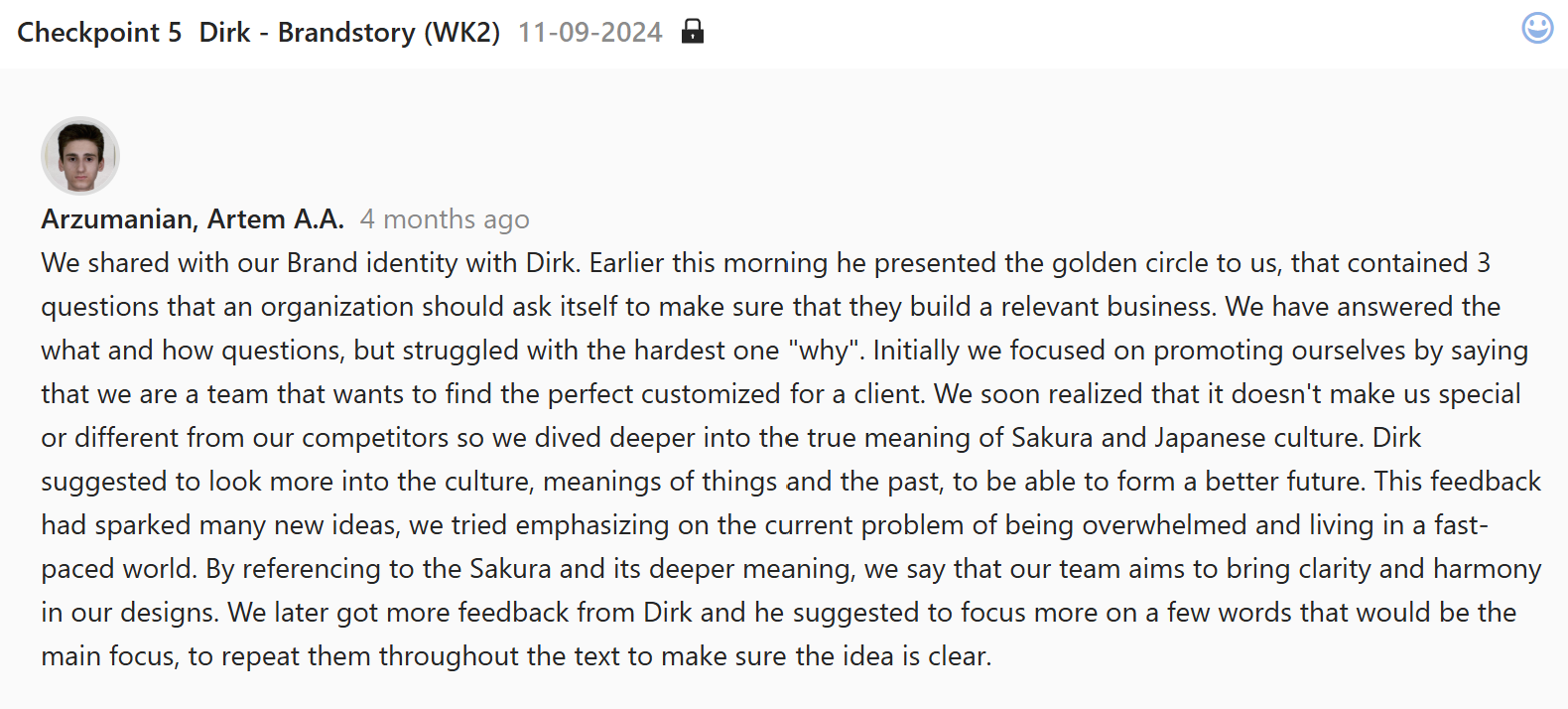
In order to create a story of our brand and clearly show what we stand for we needed to create a brand identity. Dirk gave us a lesson on the golden circle, that every company should work on when creating an organization. The circle consisted of three questions: Why(Purpose), How(Process), What(Result). My team needed to answer those questions to develop a strong identity.
Because we chose a Japanese style for our brand it was quite easy to do a small research, learn about values, traditions and meanings behind the Sakura tree. After learning that Sakura stands for balance and new beginnings I was able to answer and write down the what and how questions. The hardest part was the “Why” part. Dirk Mentioned that many businesses struggle with this question and that’s why in the long run they fail. I came up with some ideas and got feedback from Dirk in which he suggested to look deeper into the culture of Japan and find something that would differentiate our brand from the competitors. After some more research and co-reflection within my team, I managed to connect our motives to the identity that we are creating around us. The focus was on the world we live in right now, how there is so much overwhelming content embedded in our lives, here at Sakura creative we face that problem, we want to portray balance and mindfulness in our work. I also connected the way the cherry blossom works and what it represents in our identity, talking about the change and new beginnings.
It was an interesting topic to work on and despite some setbacks and challenges I found it an interesting practice to do. I haven’t thought that much about the role of the “why” question in the companies and I am glad I got taught more about that during the lesson from Dirk.
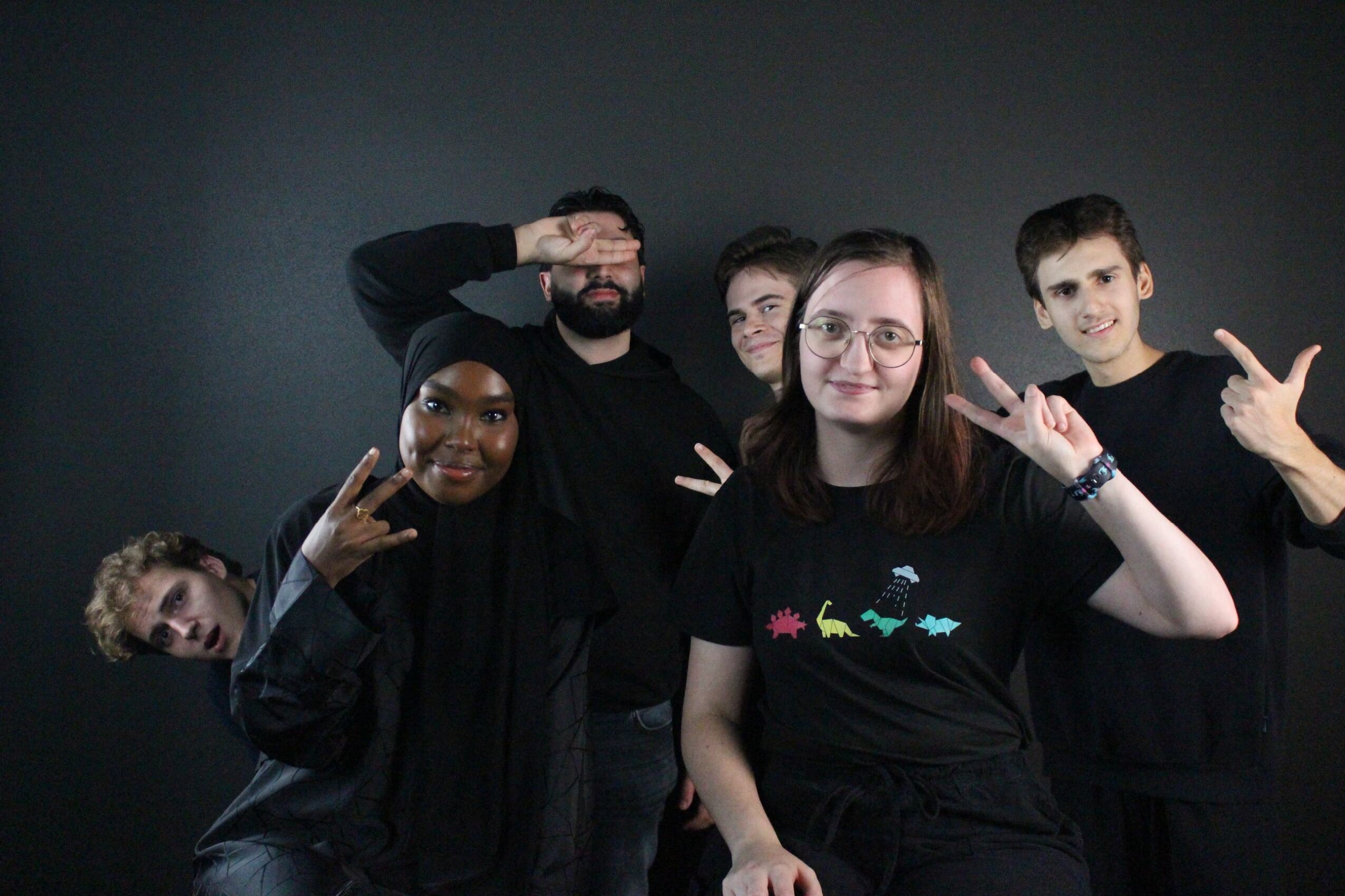
During our project we have had several stand up meetings. Initially I suggested to have a stand up meeting once or twice a week, but after discussing with the team we decided to perform them every mandatory day. So that three times a week, twice in the morning and once in the afternoon, we would get a small room and talk about what we have done and what we will do.
I have noticed that we have skipped some of the stand up meetings, proving that we have planned too many of them in a row. In the future I would suggest us to have a meeting on Monday morning and another one on Wednesday afternoon. This way we make sure we discuss what will we do from Wednesday till Monday and then on Monday we gather to show what we have done. It could be a really effective method considering that in our contract we agreed to always be present on the first three days of the week and the last two are for a portfolio.
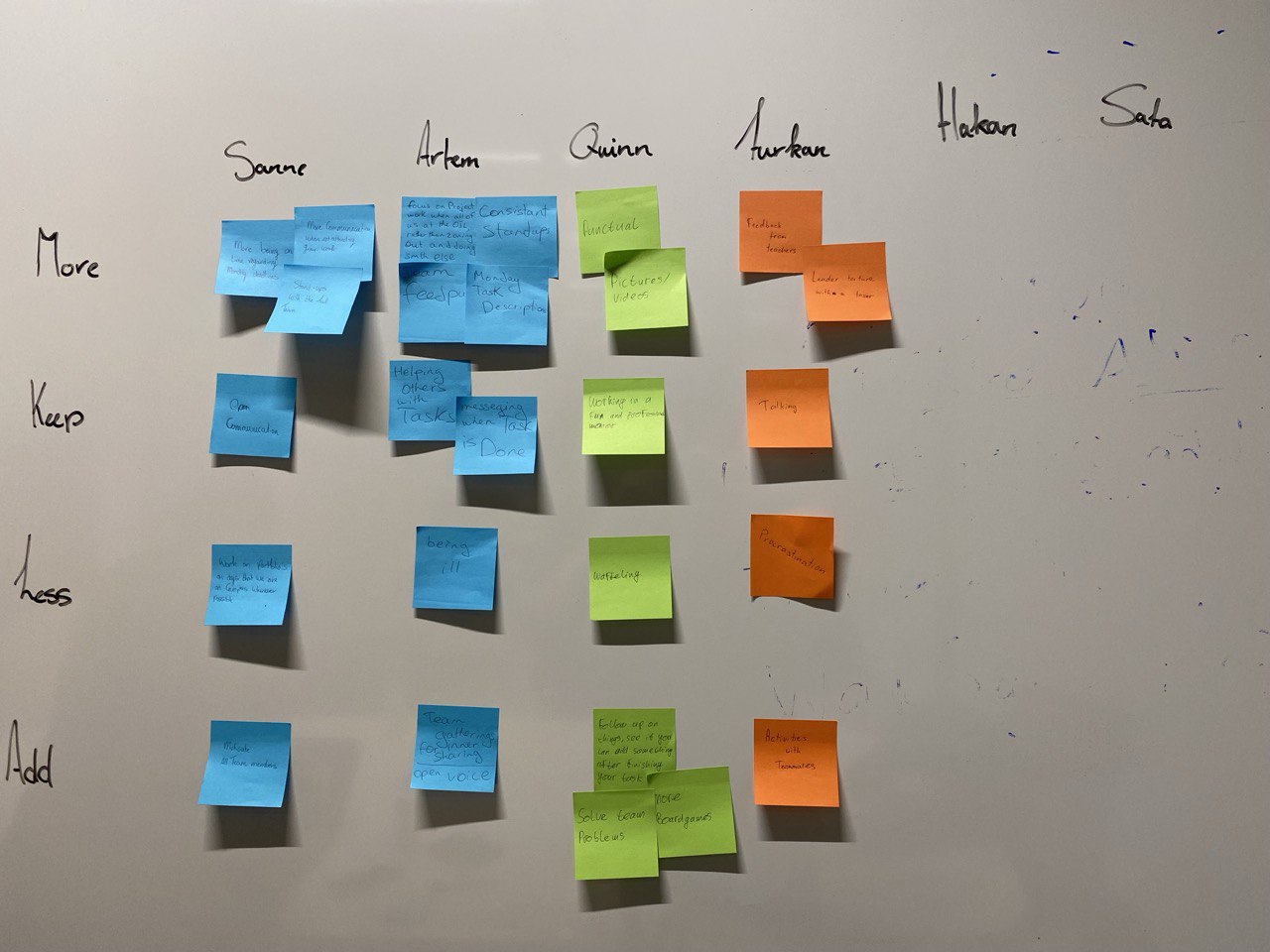
At the end of the first sprint my team had to do a retrospective to see where we are, what everyone feels and thinks of the project and so on. To perform this task I suggested we get a room so that we are in a safe space where everyone can talk freely. We found a classroom and set down around a table. Because we couldn’t find markers for the board, one of our teammates just used their tablets to write in all the feedback. We discussed what do we want more of in the team, what to add, what to reduce and what to keep the same. All of us liked the quality of the work and products that we were delivering at that point, the planning that we had and the amount of feedpulses our team gathered. The thing that wasn’t good was the time gap between the first person that comes to the university and the last one, so we needed to be more punctual. Another thing we lacked was the live working collaboration. Some of us were working on our portfolios while others were doing stuff for the team project. I think that if we delegate certain tasks to each other and when sitting with the team in the Oil communicate on what we are currently working on, then we would be able to do a better work for the team. As for now some of us might zone out of the team work and focus on their portfolio rather than the group project, which ruins both the quality of a studio project and a personal portfolio.
I think we manage the team well and with certain improvements can perfect the workflow of our group. However I noticed a significant mistake in our retrospective process. We should have used a whiteboard or sticky notes rather than having one person write down everything we say on their tablet, because then we would see the whole overview of the retrospective as well as be 10x more comfortable with sharing our thoughts, which might have not been the case this time that we tried it.
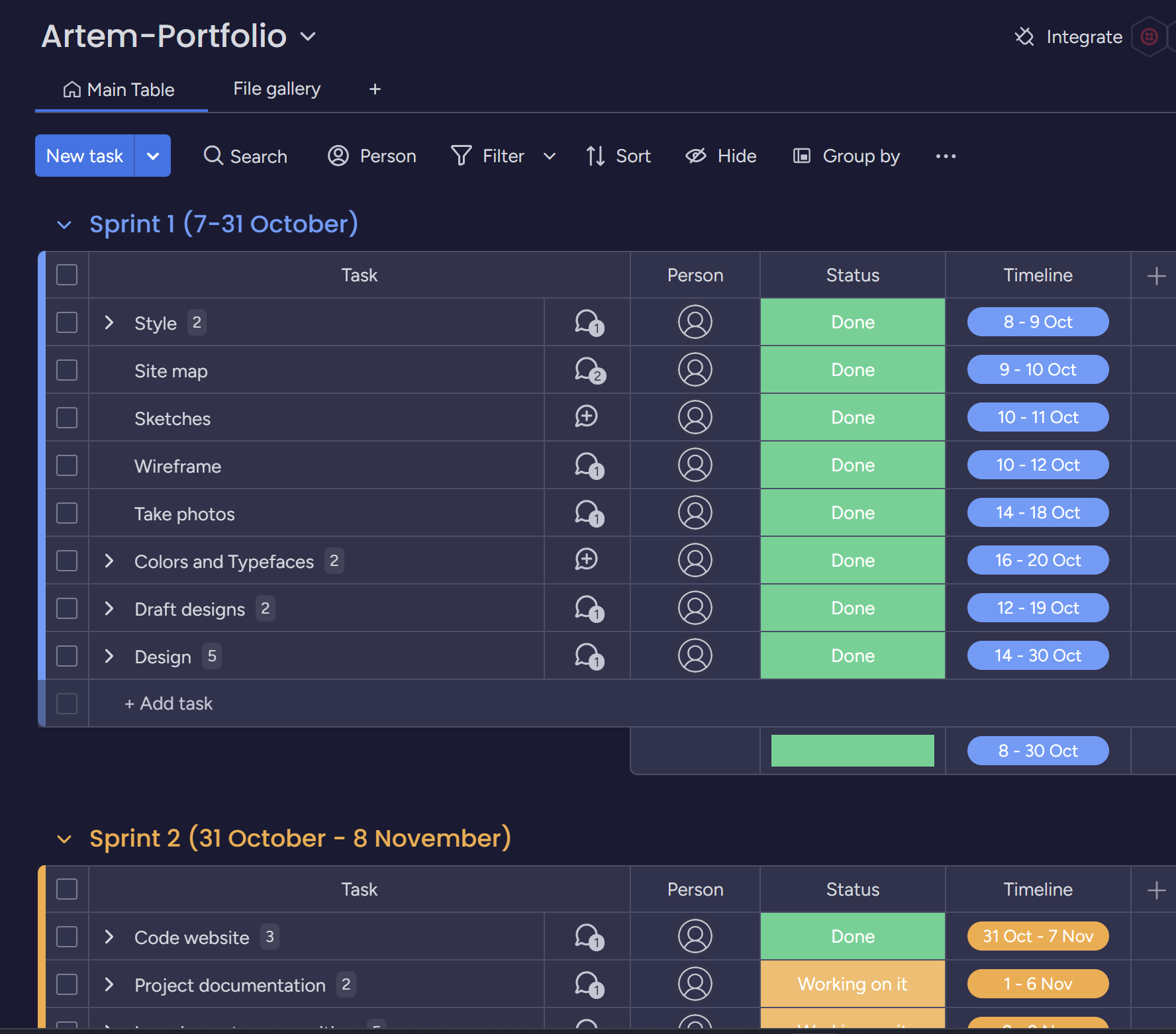
In order to organize my portfolio work I used the most heavily advertised software for planning on Youtube - Monday.
I set up the work process in a few sprints. The first sprint consisted of all the creative work that I had to do.: creating a style, wireframes, designs and so on. The second sprint consisted of coding the portfolio and writing in the learning outcomes and project documentation. I have created a timeline for all the tasks and checked the table daily to see what tasks do I have for the upcoming days what time scope there is.
I enjoyed working on this sprint planner. The Monday software ran smooth and loaded fast, I was managing to do most of the tasks in time. The only problem was that I just set too many tasks for the second review. It is incredibly hard to deliver good products in such a short time frame. I am happy that I worked hard this month and managed to do everything, but next time I should definitely leave some tasks for later.
The team and I decided to do some research on the main problem that CBR has and create sub-questions that we would all do a research on.
Together we set the main problem that was mentioned in the client presentation: Teens are finding it difficult to pass their driver's license theory and practical exams on their first attempt. This increases the likelihood of accidents and results in long waiting lines. After that me and my groupmate formed a Main research question and highlighted 6 sub questions from it. I took on the task to find solutions to a problem of not passing the driving and theory exams on the first try. I found out that one of the main causes of failing on the first try is anxiety. Stress can reduce focus and affect decision-making skills, which are essential for passing a driving exam. I searched for answers online on how to get ahold of your nerves while undergoing the driving exams and have learnt about different methods like keeping logbooks, reflection, mock exams and so on. I have also linked the necessary reference according to APA citation regulations.
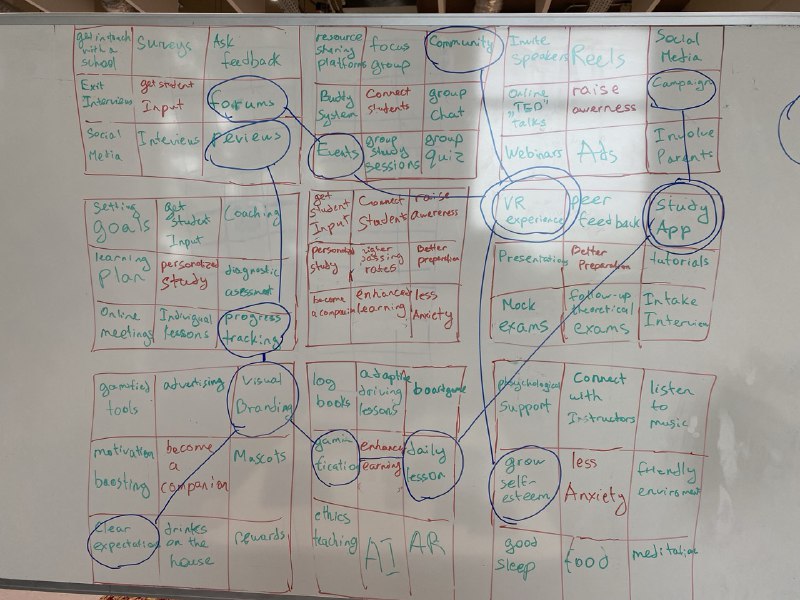
We got a lesson from Pennie about the lotus Blossom methodology and decided to implement it in our research.
I drew many squares and in the center 9 wrote down the main points that the team have already thought of at this point, then I transferred all the topics to the centers of the rest of the 3x3 squares and we started brainstorming solutions towards each theme. For example for the enhanced learning theme I came up with a concept of daily lessons and gamification of the process. This way we filled in all the squares and then I circled the main ones that we would want to focus on and build a solution around.
I liked this practice and believe it brought us way closer to the solution, however there were still some problems. Halfway through the process my teammates couldn’t come up with new ideas, they were completely stuck or they gave up, I just noticed that the last 15 or so squares were all filled in completely by me. I figured this practice requires patience and focus to finish it completely, so it is not for everyone and every case study.
At the end of each sprints my team was gathering together to do a retrospective of the progress we have made during those weeks and to share our thoughts and suggestions of improving the workflow. Usually we booked a room and using sticky notes and a board, wrote down our ideas. I suggested the team to use the structure “More, Keep, Less and Add” in order to decide what we like and dislike about the team’s performance. One of the things I have written down during one of the reflection meetings was to be more focused on the group work while we are in the OIL. I have been noticing throughout group tasks and team time we have in the OIL that some of us get completed out of the process, by doing some other stuff. We had an agreement that as a team we meet the first three days of the week and work together on the project, whilst leaving other days for personal work. My teammates were getting easily distracted during team tasks so I shared my point of view with the rest of us. Another good point my teammate has made was punctuality. We were always coming at different times despite our agreement.
Those retrospectives worked well and I noticed that the process was becoming smoother and better with time. The gap between the first and the last person coming to university was decreased a lot. And we started working together on tasks during the OIL time without getting distracted.
We got a chance to conduct an expert interview with a real driving instructor during the Partout project.
My teammate prepared a few questions that we may ask the instructor and after reviewing them together we got a finalized document from which we could ask the person. The main interview objectives were finding a correlation between the theoretical and practical exam failures, finding more about the anxiety and its role, learning about the impact of not passing the theory exams on the practical. Together with my teammate we were asking questions and create follow-up questions on spot to find more about those topics. By the end of our talks we have learnt that: Anxiety is a huge factor in this regard; People that come in anxious need a lot more hours to get confident on the street; Student needs to put in the hour and needs to grow more confident in themselves;
People who fail their theory exams two things at play:
takes longer to get their practical exams;
want to put into the extra work.
I think we did good at conducting and executing the expert interview. We learnt from it and could now use a professional opinion case to leverage our concept choices. The only thing that we might have overdone, was pushing the expert into our idea too much. We should have been more neutral in our questions and preferences to get honest feedback.
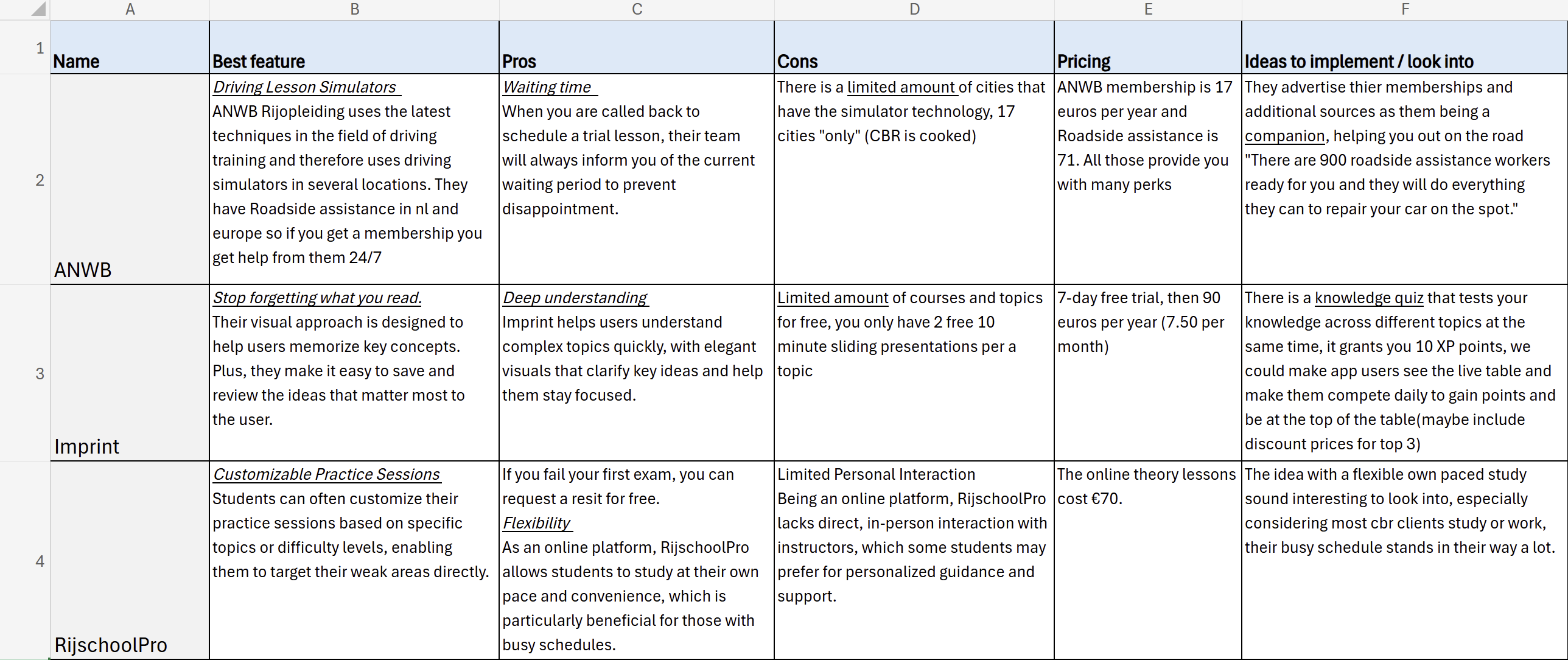
During the Partout project I suggested my team to perform some competitor analysis to learn about their pros and cons and be more aware of the markets competition. For that I have created an excel sheet in which we would have to write a company name, their best feature, pros, cons, pricings and general ideas we can look into ourselves. I shared with this file in teams and me and few people started to work on filling in the table. I have found three companies who I could call indirect competitors of CBR. I liked the ANWB’s feature of having driving simulator locations across a few cities. This has sparked an idea to create or own VR/AR solution that we perused in the future. Another big thing was the lessons structure from Imprint. The app teachers different topics, from philosophy to health using short content with animations and images. That cool feature of theirs inspired me to include this type of learning system in our own product.
By the end of the process I have learnt a lot from the competition and managed to utilize their strengths in our product concept.
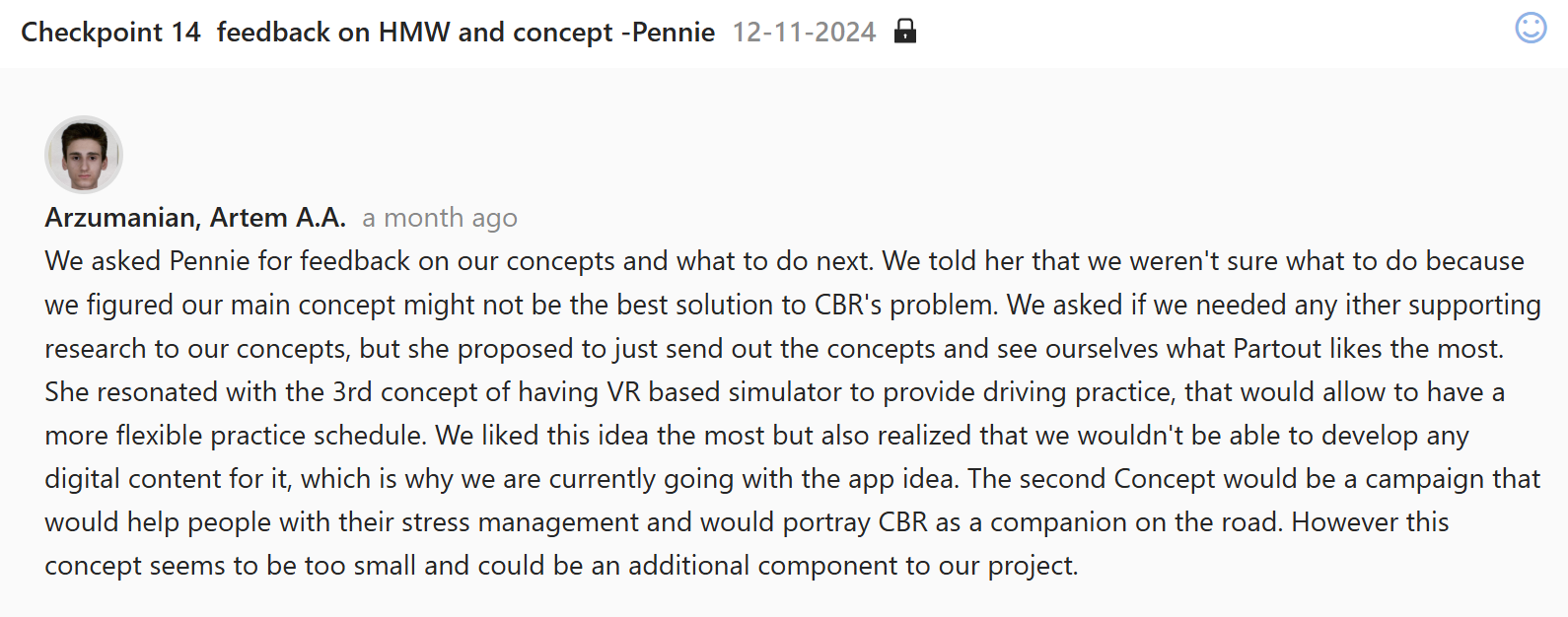
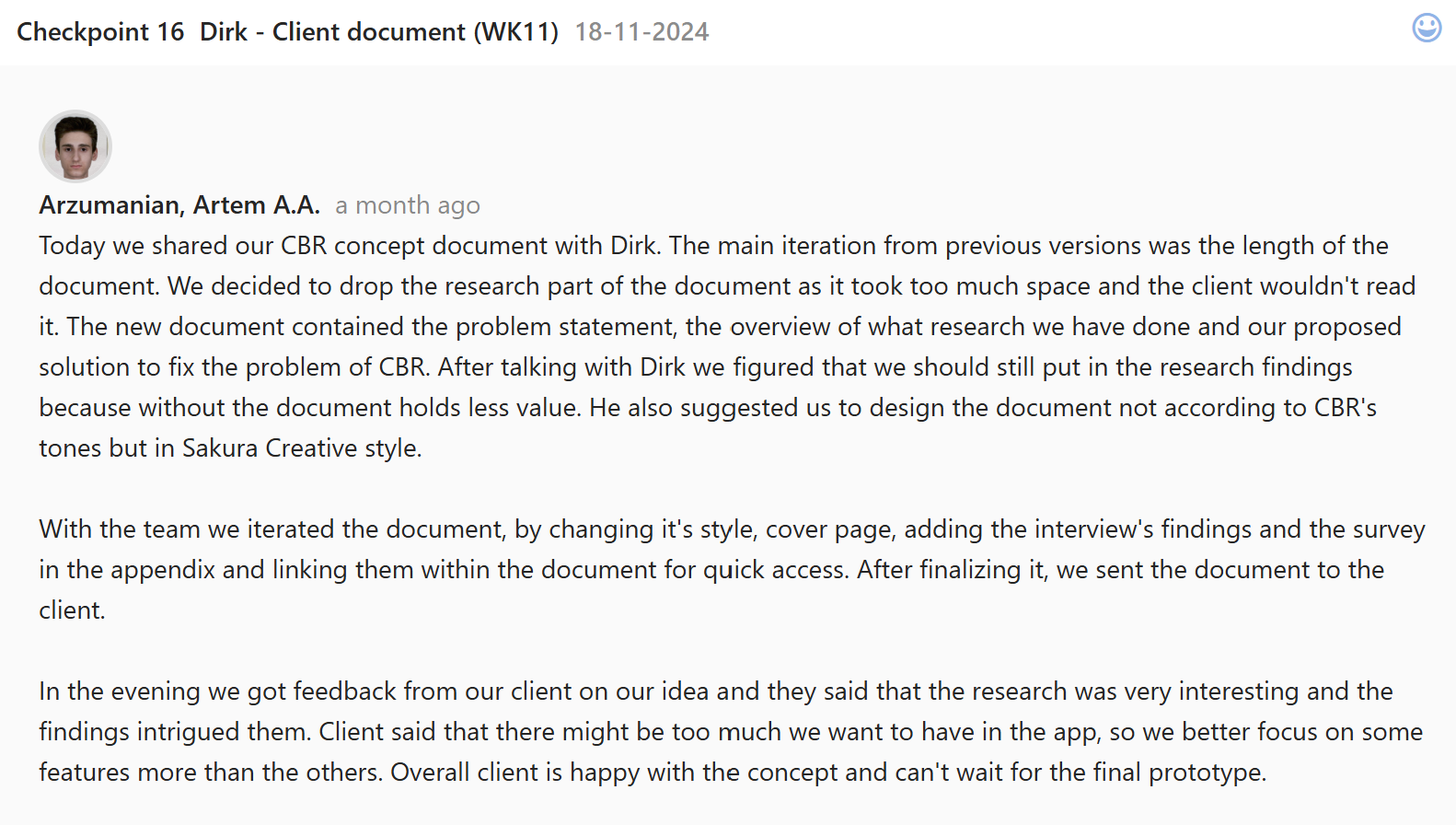
By the end of the research phase I had to create a concept document with my team to promote our idea to the client and validate it, so we could start executing it.
I have written the problem statement first to show that we understand what the needs are. Then I talked about the research takeaways and findings. I wrote a short text about it and within the document linked the survey findings and library research, so the client could take a look at that in the appendix. I then proposed our solution and provided a sitemap I created to help visualize our idea a bit. It didn’t matter if the sitemap is fully settled, however it was important to show that we have already made some progress in it and have taken action. Lastly by adding a conclusion I summarized what the documents concept was once again. After doing that my teammates helped me decorate and adjust the content to be in Sakura Creative style and we sent it of to the client.
Closing to the end of the project I created an advisory report for Partout to further on instruct them how to use our app and summarize its key features.
I started the document with a table of content showcasing what it contains. The first section of the report was a summary, that represented what that advisory document stands for. Then I mention the app’s overview with its main purpose and idea. I then describe the main features and ways to implement them like:
AR car parts learning
Functionality: Using augmented reality by displaying the car in front of you with your phone and being able to explore and learn different car parts and their functions.
Implementation: Collaborate with companies/teams that could develop an interactive car model that would have clickable and zoomable parts.
Finally I added additional recommendations and a conclusion to sum up the report.
My teammates all liked the document I created and it served as a great asset in the final concept document that my team was developing.
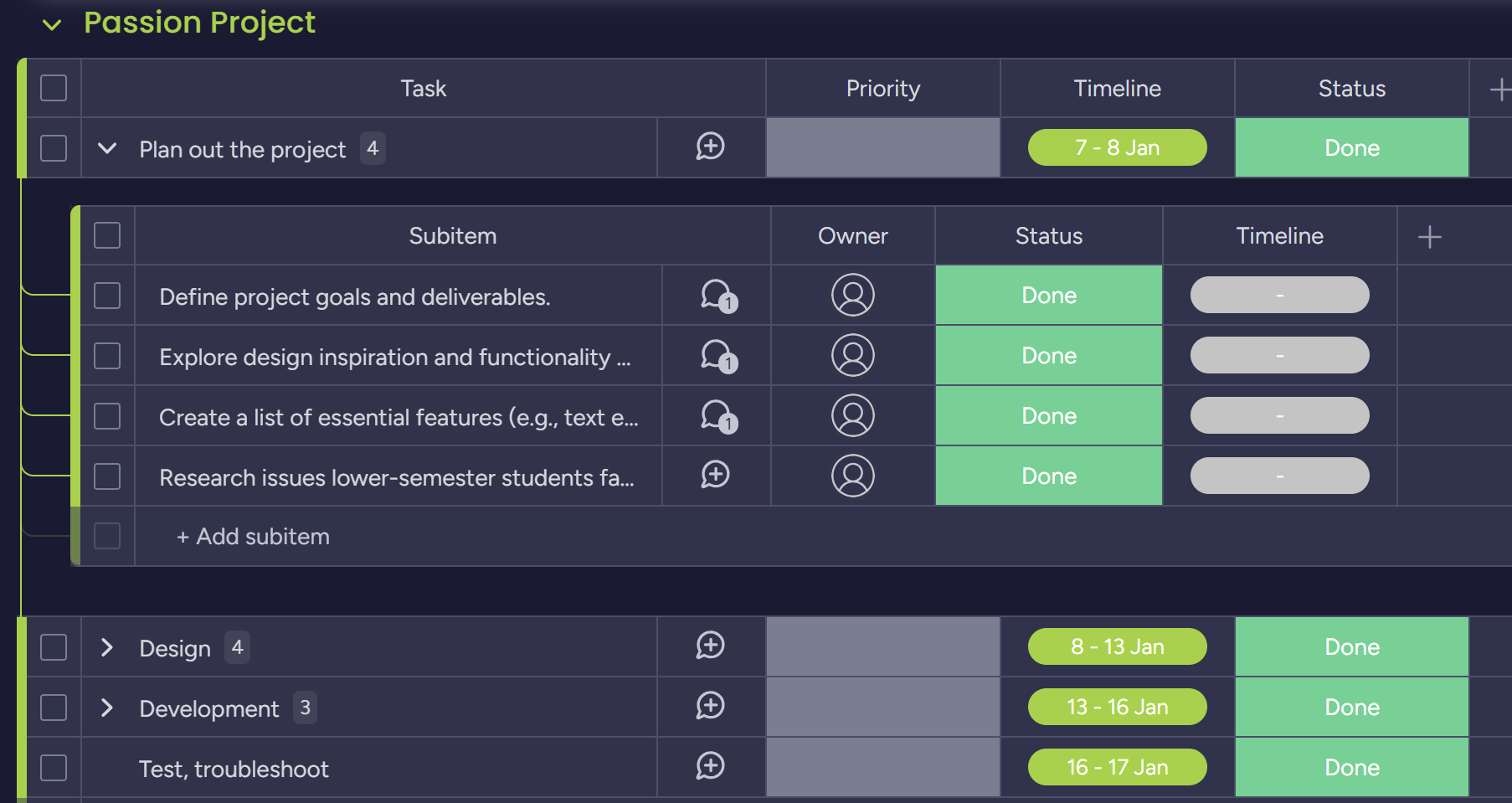
The first thing I did for the passion project was setting up the timeline chart for the workflow. The project was time consuming and I didn’t have any time to consume, so I had to carefully prioritize my work, day by day.
I actually managed to pull of a hard project on time, which proves that my system worked. The best thing about it was that I always knew what to do. The chart has set a clear path to succeeding and I love that I did not just half ass this project, but went through the whole cycle. I found the stakeholders, did some research, created documents, listed the features that needed to be in the tool. Created various site flows explaining users view of the tool and its offerings. The project turned out great and the chart assisted greatly.
Even though I didn’t need to cerate a project scope, I still wanted to perform that practice to just get used to it as a good habit. The document was used for identifying and setting clear goals that I want to achieve by the end of the project. There is a wise saying, that if you can clearly imagine and write what you want and how you want it, you are already 50% there.
The scope I wrote turned out quite insightful for the people who are not yet introduced to my project, so it is worth reading. I stated the target audience, requirements, deliverables that I want to see and most of all, I managed to achieve all that my the end of my project.